
Customs clearance in Georgia 2026: new fees and how to count expenses.
30.06.2023
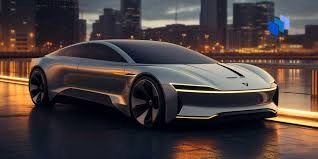
Autopilot and AI in Cars: How Autonomous driving works
The transition from human-operated vehicles to AI-driven transportation is the most profound disruption in the automotive industry since the combustion engine. This shift is not merely about driver convenience; it is a fundamental restructuring of hardware engineering, software development, urban infrastructure, and global vehicular economics.
The integration of Autopilot systems and Artificial Intelligence (AI) transforms vehicles into sophisticated "Software-Defined Vehicles" (SDVs). This comprehensive analysis breaks down the specific hardware ecosystems, algorithmic processes, legal frameworks, and economic realities driving this revolution.
The Hardware Ecosystem: Advanced Sensor Fusion
To operate autonomously, a vehicle must perceive its environment with greater accuracy and speed than a human. No single sensor is perfect in all conditions, which is why manufacturers rely on Sensor Fusion-the continuous, real-time synthesis of data from multiple hardware sources to create a fail-safe, 360-degree environmental model.
1. High-Definition Cameras (Computer Vision)
Cameras are the only sensors capable of interpreting color and high-resolution visual data. They are crucial for reading speed limits, identifying traffic light colors, and understanding lane delineations.
- The Challenge: Cameras have passive sensors; they rely on ambient light. They struggle with high-contrast environments (e.g., exiting a dark tunnel into bright sunlight) and are easily compromised by rain, mud, or direct glare.
- Industry Application: Companies like Tesla rely almost exclusively on a "Pure Vision" approach, arguing that since human drivers navigate using only visual input (eyes) and neural processing (brains), cars can do the same using cameras and advanced neural networks, effectively eliminating the need for expensive LiDAR.
2. Radar (Radio Detection and Ranging)
Radars emit radio waves that bounce off objects, calculating distance and velocity using the Doppler effect.
- Advantages: Radar operates flawlessly in extreme weather (heavy fog, snow, torrential rain) and pitch darkness.
- Evolution: The industry is moving from standard 2D radar to 4D Imaging Radar, which provides height information alongside distance, azimuth, and velocity, creating a low-resolution point cloud that approaches LiDAR capabilities at a fraction of the cost.
3. LiDAR (Light Detection and Ranging)
LiDAR fires millions of laser pulses per second, measuring the time it takes for the light to bounce back (Time-of-Flight). This generates a highly precise, millimeter-accurate 3D topographic map (a "point cloud") of the car's surroundings.
- Advantages: It provides perfect spatial awareness and depth perception, regardless of lighting conditions.
- Industry Application: Companies like Waymo (Google) and Cruise view LiDAR as non-negotiable for Level 4 and Level 5 autonomy. Historically costing upward of $75,000 per unit, mass production and solid-state technology have driven LiDAR costs down to a few hundred dollars.
4. Ultrasonic Sensors
Operating via high-frequency sound waves, these sensors are embedded in bumpers for ultra-close-range detection (0 to 3 meters). They are exclusively used for low-speed maneuvering, automated parallel parking, and blind-spot monitoring.
Level |
Name |
Who drives |
Real Example |
0 |
Without Automatization |
Driver 100% |
Any car |
1 |
Driver’s assistant |
Driver + One system |
Adaptive Cruise Control |
2 |
Partly automatization |
Driver + Two systems |
Tesla Autopilot |
3 |
Conditional automatization |
System (Driver is reserve) |
Mercedes Drive Pilot |
4 |
High-end automatization |
System (Geofance) |
Waymo Robotaxi |
5 |
Full autonomy |
System (Everywhere) |
Doesn’t exist yet |
Software Architecture: How Automotive AI Thinks
Having hardware to "see" the environment is useless without software to understand it. The vehicle's AI operates through a continuous, four-step algorithmic pipeline executed in fractions of a second.
1. Perception
The AI ingests the fused sensor data and categorizes objects using deep neural networks. It performs Semantic Segmentation (classifying every pixel in a camera feed as road, sky, vehicle, or pedestrian) and Object Detection (drawing bounding boxes around hazards).
2. Prediction
Perception is identifying a bicycle; prediction is anticipating its next move. Using Machine Learning models trained on billions of miles of real-world driving data, the AI calculates the probability of future states. Will the pedestrian cross the street? Will the truck merge into this lane?
3. Path Planning
Based on predictive models, the vehicle plots its optimal trajectory. It calculates a route that complies with traffic laws, avoids collisions, and optimizes for passenger comfort (avoiding sudden, jerky steering).
4. Control
The software sends electrical signals to the vehicle’s physical actuators-the drive-by-wire systems. It applies the exact torque to the steering motor, pressure to the braking system, and power to the electric drivetrain.
Edge Computing vs. Cloud Computing
Autonomous driving cannot rely on Cloud computing for immediate driving decisions due to network latency; a car traveling at 100 km/h cannot wait 200 milliseconds for a server response to apply the brakes. Therefore, vehicles are equipped with massive onboard supercomputers (like the NVIDIA DRIVE platform) capable of trillions of operations per second (TOPS). This localized processing is known as Edge Computing. The Cloud is reserved strictly for non-urgent tasks: downloading HD map updates, uploading unique driving anomalies (Shadow Mode), and updating the AI models overnight.
The 6 Levels of Autonomy: The SAE Standard
The Society of Automotive Engineers (SAE) classifies automation into six distinct levels, defining the exact threshold of legal and operational liability.
- Level 0 (No Automation): Pure human driving. Features like automatic emergency breaking (AEB) belong here, as they are reactionary, not continuous driving systems.
- Level 1 (Driver Assistance): The system controls either steering (Lane Keep Assist) or speed (Adaptive Cruise Control), but never both simultaneously.
- Level 2 (Partial Automation): The system controls both steering and acceleration (e.g., Tesla Autopilot, Ford BlueCruise). Crucial distinction: The human driver always remains fully legally responsible for the vehicle and must monitor the road constantly.
- Level 3 (Conditional Automation): The paradigm shift. The car drives itself under specific conditions (e.g., highway traffic jams under 60 km/h). When the system is engaged, the manufacturer assumes legal liability for any accidents. Mercedes-Benz’s Drive Pilot is currently one of the few certified Level 3 systems in the world.
- Level 4 (High Automation): The vehicle handles all driving tasks within a strictly mapped geofenced area (e.g., Waymo robotaxis in Phoenix or San Francisco). There is no expectation for human intervention; a human passenger might not even have a steering wheel.
- Level 5 (Full Automation): The theoretical endpoint. The vehicle can navigate any road, in any extreme weather condition, anywhere in the world, identically to an expert human driver. No such vehicle currently exists.
Economic Transformation: SaaS, Auto Leasing, and Insurance
The shift to Software-Defined Vehicles is upending the traditional automotive business model.
1. Software as a Service (SaaS) in Automotive
Automakers are transitioning from purely hardware sales to high-margin software revenue. Customers can purchase a car with all hardware pre-installed hardware but must pay monthly subscription fees to unlock features. This includes paying monthly for advanced Autopilot features, battery range optimization, or performance boosts via Over-The-Air (OTA) updates.
2. The Dominance of Auto Leasing
Because vehicles are now rapidly evolving technology products, much like smartphones - they suffer from technological obsolescence. A 2020 vehicle's computer processors may lack the power to run 2026 AI software. Consequently, consumers are heavily pivoting to short-term leasing. This guarantees the user is always driving hardware capable of running the latest autonomous algorithms, while the leasing companies handle vehicle depreciation.
3. The Collapse of Traditional Auto Insurance
Currently, auto insurance is a Business-to-Consumer (B2C) model based on individual human risk (age, driving history). As we move to Level 3 and Level 4 autonomy, the AI is doing the driving. If an autonomous system crashes, liability shifts from the passenger to the software developer or manufacturer. Auto insurance will transition to a Business-to-Business (B2B) product liability model, fundamentally disrupting the $800 billion global auto insurance industry.
Smart Infrastructure: The V2X Ecosystem
For vehicles to achieve Level 5 autonomy efficiently, they must stop operating in isolation and begin communicating with their environment. This requires a Vehicle-to-Everything (V2X) communication protocol, powered by ultra-low-latency 5G networks.
- V2V (Vehicle-to-Vehicle): Cars share speed, heading, and braking status with each other. If a car three vehicles ahead slams on its brakes, your car knows instantly-before human reaction time or radar line-of-sight can register it-and begins decelerating.
- V2I (Vehicle-to-Infrastructure): Communication with traffic lights, toll booths, and smart road signs. Cars can adjust their speed perfectly to hit a "green light wave," drastically reducing city traffic congestion and emissions.
- V2N (Vehicle-to-Network): Cloud connectivity for real-time routing, weather updates, and fleet-wide software patches.
- V2P (Vehicle-to-Pedestrian): Future integration with pedestrian smartphones or wearables to alert both the vehicle and the human of an impending intersection conflict.
Critical Roadblocks to Full Autonomy
Despite billions in R&D, deploying Level 5 autonomy globally faces massive unresolved challenges.
- The "Long Tail" of Edge Cases: AI is excellent at handling 99% of normal driving situations. The problem is the final 1% chaotic, unpredictable anomalies. Examples include a pedestrian dressed in a bizarre costume, a reflection on a wet road mimicking a barrier, or an animal exhibiting erratic behavior. Training AI to handle this infinite "long-tail" scenarios without hallucinating or initiating emergency stops is the industry's hardest problem.
- Cybersecurity Threats: An autonomous vehicle is essentially a 4,000-pound moving computer. Exploitable vulnerabilities in the CAN bus (Controller Area Network) or V2X networks could allow bad actors to remotely hijack vehicle controls, spoof sensor data (making the car see obstacles that aren't there), or execute massive ransomware attacks across a manufacturer's entire fleet.
- Algorithmic Ethics: In an unavoidable crash scenario where a vehicle loses traction, does the AI calculate impact trajectories to prioritize the safety of the vehicle's occupants, or does it swerve to minimize overall casualties, even if it endangers the passenger? Programming these moral frameworks presents unprecedented legal and philosophical dilemmas.
Summary
The development of Autopilot and AI in the automotive sector has moved past the phase of speculative research and entered commercial reality. By combining advanced sensor fusion with deep neural networks and edge computing, automakers are creating vehicles capable of perceiving and reacting to the world faster than humans. While absolute Level 5 autonomy is restricted by cybersecurity, edge-case data training, and legal frameworks, the economic paradigm has already shifted. Software-defined vehicles are redefining insurance, popularizing hardware leasing, and forcing the implementation of smart-city infrastructure, setting the foundation for the next century of global transportation.